Monday, 31 January 2011

Horror Mood Board

The crow - used for horror films all the time, most notabley in 'The Omen' (1976)
Classic scene from the original Dawn Of The Dead (1978) Zombies being the scariest of movie monsters.
King Kong, while tame by todays standards this monster scared a generation.
Leatherface is an icon in the horror world. One of the best known movie antagonists ever. Stalking the backwoods of USA since 1974.
Psycho set the benchmark for slashers. A timeless classic.
The wolfman is an iconic movie monster. And below, Ghostface from the popular Scream trilogy, a well known serial killer.

Thriller Mood Board

John Mclane from the classic Die Hard. An iconic thriller film and character.
Often viewed as a horror but it is actually a thriller.
Psychological thrilliers are more and more popular nowadays.
Ideal setting for a terrorism based thriller.
Iconic clip from an iconic thriller.
Robert DeNiro playing the psycho brilliantly.
A classic thriller, The Third Man. And below, again perfect for a terror based thriller.

Monday, 17 January 2011

Rom-Com Mood Board

often used in a rom-com, the romantic dinner for two.
typical aspect in a rom-com, lovey dovey gesture.


typical aspect in a rom-com, lovey dovey gesture.
 
 
Wedding's are the opytomy of love.

romantic beach getaway
popular 'toff' in rom-coms.

Sunday, 2 January 2011

Christian Metz Model of Genre Development

Christian Metz, in his book Language And Cinema (1974) explored the development of genre film and suggested that each genre passes through four phases of existence. The four phases being;
Christian Metz

Experimental

This term refers to the phase of early films which explored and experimented with the different genres. For example, and Experimental Thriller film would be the film M (1931) as it is one of the first Thriller films. An example of an Experimental Horror film would be Nosferatu (1922).

Classic

This refers to the phase of films which established the narrative conventions within a certain genre of films in its most successful and defining period. For example, a Classic Horror film would be Dracula (1931) and a Classic Rom-Com would be Annie Hall (1977).

Parody

This refers to the films that have mimicked and mocked the genres in some sort of comical way. For example, Scary Movie (2000) is a Parody of a lot of popular Horror Films and Date Movie (2006) is a Parody of popular Rom-Coms.

Deconstruction

This refers to films that have taken the generic elements of the genre and amalgamated them into varying sub-genres. For example, Seven (1995), Saw (2004) and Scream (1996) all could be considered Horror films due to certain elements. Seven and Saw however both incorporate traits of a psychological thriller, Scream on the other hand incorporates some elements of a Parody film and also elements of a slasher film - which is a sub genre of Horror. An example of a Deconstruction Rom-Com would be a Shaun of the Dead (2004) as this film incorporates the Horror film trait of Zombies.

Thursday, 30 December 2010

Questionnaire Findings

I conducted a questionnaire to try and help me find out different peoples feelings on Horrors, Romantic-Comedies and Thrillers.

-What their favourite film from each of the genres was
-Which type of killer they most like to see in a horror film
-What their favourite aspects are within a horror film
-Whether they like pre-title sequences or prefer to jump straight into the action
-Which gender they prefer the protagonists in a horror film to be
-What kind of music they expect in a thriller
-Whether they prefer English or American Rom-Coms
-And finally, which of the three genres is their favourite

Out of the 9 responses I got, 2 people picked 'Scream' and 'Saw' as their favourite Horror films. Other choices were 'Jeepers Creepers', 'Case 39', 'The Orphan', 'Paranormal Activity' and 'House of Wax.' This shows that with Horror films, due to the amount, people have very different tastes in Horror Films and different things they like.

With Rom-Coms, 4 people chose Love Actually as their favourite, the other 4 were all different. They were 'Just Like Heaven', 'The Wedding Planner', 'Bridget Jones' and 'The Proposal.' One person didn't vote, showing that they do not like films from this genre. Due to the fact Love Actually is clearly very popular I think its clear that people tend to look for the same thing when watching Rom-Coms.

With Thrillers, 4 people chose 'Seven' as their favourite. Other films picked were 'Saw', 'Scream', 'Shutter Island', and 'Red Dragon.' These results show that some people do not know how to define films, as 'Scream' is a slasher film and 'Saw' is a horror film. It also shows that people like films that have big twists at the end, like 'Seven' and 'Shutter Island.'

When watching Horror films,  of the 9 people I asked, four prefer the antagonist to just be a plain old Serial Killer. Two people prefer the killer to be a Terrorist, two people prefer Mutated Freaks, and one person prefers a Psychopathic Killer. This shows that due to the wide variety of horror films out, people have different opinions of what makes a good horror film.

Peoples favourite aspects of Horror films, for the most part were "when you don't learn who the killer is until the end, as it builds the tension, plays on your mind, and often ends in a twist." Other popular answers were; "the scary parts" and "the killings." I think this shows that most people look for the same thing in a horror film really, and generally know what they are going to see.

5 of the 9 people asked prefer the protagonist in a horror film to be a male character, the other 4 prefer females to be the protagonists. As this is almost a 50-50 split I believe this shows that males asked prefer male protagonists and females asked prefer female protagonists.

When asked what music people expect at the start of a Thriller film 5 of the 9 people said "eerie, creepy piano music that builds up tension." Other choices were "loud, thrashy music" and "jumpy, twisted music." Again I think the limited responses show people think that generally you get the same thing at the start of most Thriller films.

5 people prefer English Rom-Com's to American. 3 prefer American, with the final 1 saying they are the same on the most part and not making a choice. I think people prefer the English versions because they can probably relate to them more, and I think people chose American because they tend to be a lot happier than the English equivalents.

I found that 5 people prefer Thrillers, 3 prefer Rom-Com's and only 1 prefers Horror films. This shows the difference in taste that people had. I am surprised that only 1 person prefers Horror films as usually they are very popular with the 16-18 year old audience, which is the age range of the people asked for this questionnaire.

Saturday, 4 December 2010

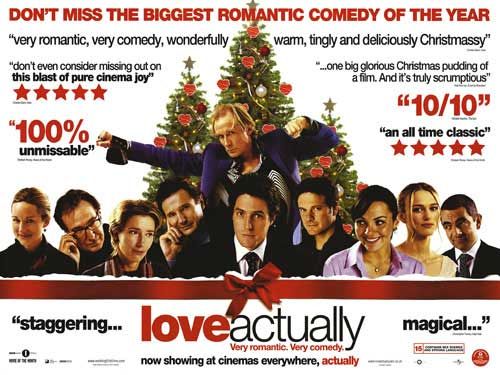
Love Actually (2003)


Love Actually

Love Actually is a 2003 Romantic-Comedy film directed and written by Richard Curtis. The films cast is rather large, but consists of a wealth of well-known British actors such as Hugh Grant, Alan Rickman, Emma Thompson, Colin Firth, Keira Knightly and Liam Neeson.

The film revolves around the lovelives of 10 couples in the lead up to Christmas, as well as a epilogue set one month after Christmas. Most of the stories intertwine with the other stories in the film as we find that nearly all of the characters are linked in some way. 

The film was produced on a budget of around £30,000,000 and made a gross profit of around $247,472,278 worldwide making the film a huge success. It was nominated for a large number of awards and won a host of them.

Opening Sequence

Camera Angles 

In the opening sequence there are a lot of close-ups used to show happiness in the faces of the people, which shows their love for the people returning to the airport. Then as the characters are introduced we again get a lot of close-ups used to show the expressions on the faces. In some cases they are happy expressions meaning that there is love in their life, but there are some sad facial expressions to suggest that the love is gone from their lives.

Mise-en-Scene

The first letter of each actors name is in red type, red is often a sign of love and passion so it fits with the title of the film.
  The wedding at the start of the film epitomises what the film is about as to get married is the ultimate sign that you love someone. There is a lot of light in the church which shows that it is something good happening. In fact, all throughout the opening a lot of high key lighting is used.
  At the very start, there is a montage at the arrivals gate of Heathrow where we see real people meeting their partners, family and friends and you can see the love and happiness of everyone.

Editing

There are a lot of cuts used in the montage so that the audience can see just how many happy people there are at the airport. There are also a lot of cuts used to introduce all of the characters which has to happen due to the number of them.

Sound

There is a voice over from Hugh Grant, who is one of the main characters, as we see the montage and he talks about how love is part of everyday life, and no matter what bad things may happen, love is always a prominent thing. He also says the words "love actually" which then turns into the title.
  As we see the montage there is a very soft, quiet piano playing a song to show the delicacy of love.

Thursday, 2 December 2010

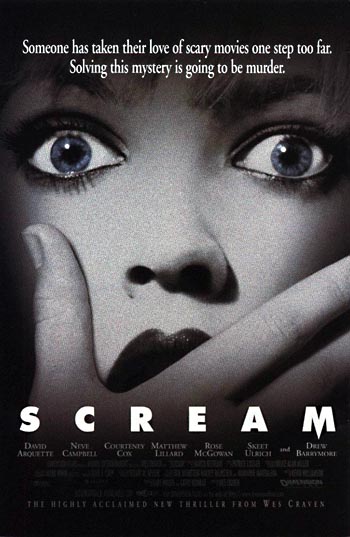
Scream (1996)


Scream is an American Horror film directed by Wes Craven that was released in 1996. The film tells the story of the fictional town of Woodsboro, California being terrorized by a masked killer who enjoys tormenting his victims with phone calls and movie references. The killer's main target is Sidney Prescott (Neve Campbell), a teenage girl whose mother, Maureen, fell victim to a brutal murder one year earlier. The film takes the form of a "whodunit" mystery, with many of her friends and townspeople being fellow targets and suspects.

Drew Barrymore being terrorized by Ghostface
Scream was a box office success, grossing $173,046,663 internationally in it's 15 years and also spawning 2 sequels with a third sequel soon to be released and also a further two films in the pipeline. Scream is famed for revamping the Slasher genre, much like Halloween did in the late 70's using its standard Horror steretypes with a tongue-in-cheek attitude.

The film clearly takes notes from Hitchcocks' 'Psycho' (1960) from it's use of a maniac with a knife, to killing off one of the better known actresses in the first five minutes, which was considered very strange when Drew Barrymore's face had been a focal point of the film posters and alot of the advertising.


Opening Credits

Camera Angles

The scene starts with a close-up of a ringing telephone, which is quickly answered by Drew Barrymores' character. We then get a close up of her face as she talks to the mysterious male on the other end. We get a pan to show is the exterior of the house which then leads into a long shot from the outside of the house showing a swing set in the garden, which is gently swaying, perhaps to suggest that it is a windy night, or more likely to suggest someone has just been on/ near it. As 'Casey' becomes more frustrated and agitated by this mystery caller we follow her through her house until she stops and turns suddenly at which point we get a close-up of her face which shows fear, which allows suspense and tension to build. Other notable shots come as exterior shots, firstly we see fog in the garden, which is used to a creepy, tension building effect to suggest a dark, broody atmosphere, we also get a shot of 'Steve' tied up and bloodied which makes it evident something is about to happen.

Mise-En-Scene

The title shows up first in white on a black background, but then as we hear a gunshot becomes red which suggests blood and is more conventional with a Horror film. The location of the house is the American Suburbs, we can tell this by the exterior shots of the house used, which sets the very conventional 'girl alone in a quiet neighbourhood, in distress' situation. The girl in question, 'Casey Becker' is a very stereotypical ditzy blonde often found in Horror films, this is because Scream itself is meant to parody and make fun of the generic Horror film. 'Steve', 'Casey's' boyfriend is again a Horror stereotype being a jock, however unlike most Horror films this jock is shown as weak as he has already fallen to 'Ghostface', the unseen killer, meaning he will not be swooping in to save the damsel, which is what normally happens. While in this section 'Ghostface' is not seen, he is mentioned, all be it subtley. When asked what her favourite scary movie is, 'Casey' responds with "Halloween, you know, the one with the guy in the white mask?" This exophoric reference, while refering the Michael Myers, also refers to the antagonist of Scream.

Sound

The first three sounds we hear are a phone ring, a scream and a gunshot. The phone ringing, which starts as non-diegetic but moves to diegetic, sets the first shot of the movie, the scream clearly links with the title, and the gunshot is used to turn the title from white font to red. We also get a conversation, where as the scene goes on, one of the participants becomes distressed which is used to create suspense, also during the conversation we get a monotonus, loud drum beat as the situation becomes worse.

Editing
The only editing used in this scene really is simple cuts from shot to shot, when there is supposed to be suspense and tension the cuts are quicker than normal. There are a mix of seamless and continuity cuts used throughout the scene.